
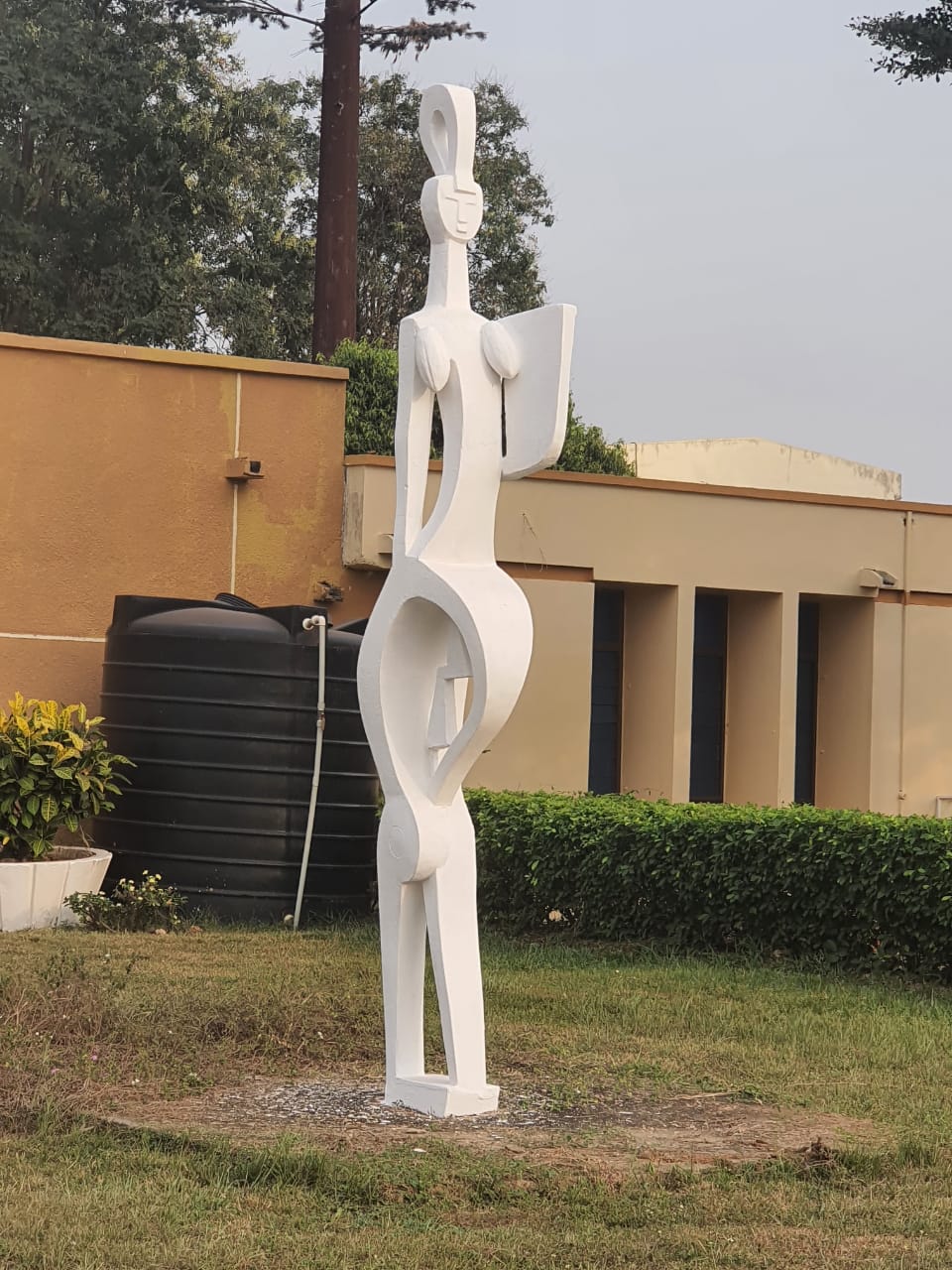
On the forecourt of the old Pharmacy Block at the Kwame Nkrumah University of Science and Technology (KNUST), Kumasi, a radical figure stands watch. Cast in concrete in the early 1960s, School Girl is one of three monumental sculptures commissioned by the University from pioneering KNUST student John Christopher Okyere, alongside Lonely Woman and Couple, located near the KNUST Children’s Library.
Less discussed than its counterparts, School Girl may be the most intellectually direct and institutionally prophetic of the trio.
Created between 1963 and 1965, at a moment when KNUST was redefining itself as an African-centred science and technology university, the sculpture embodies both the optimism and tensions of post-Independence Ghana. It is not merely decorative.
The work functions as a visual argument about education, inclusion, and the future of knowledge production.
At first glance, School Girl appears playful. Closer inspection, however, reveals a form constructed through deliberate symbolic substitutions.
The figure’s breasts are rendered as cocoa pods, an explicit reference to agriculture, the backbone of Ghana’s economy and a foundational pillar of the University’s academic orientation. Her legs take the form of a pair of compasses, evoking architecture, precision, engineering, and the applied sciences.
Unlike Lonely Woman, whose facial features are abstracted to the point of ambiguity, School Girl is given a recognisable face, with stylised eyes, nose, and mouth. A looped form crowns the head, suggestive of an indigenous coiffure associated with young women, while one arm cradles a flat, rectangular form commonly interpreted as a book, an unmistakable symbol of learning.
In a single figure, Okyere fuses the body of a young schoolgirl with the material languages of multiple faculties. Education, culture, labour, science, agriculture, and design converge into one composite form.
The approach recalls the Renaissance composite portraits of Giuseppe Arcimboldo, in which fruits, tools, and objects assemble into human likenesses. Here, however, the technique is repurposed for an African university context.
The message is explicit: education is interdisciplinary, and the modern African subject is formed at the intersection of multiple fields, a philosophy that has since become central to KNUST’s problem-solving ethos.
Where Lonely Woman invites philosophical rumination and layered interpretation, School Girl is overtly didactic. It teaches and points. Okyere pushes polymorphism to near-instructional clarity, advancing a message of learning, formation, and intellectual integration.
The choice of a schoolgirl, rather than a generic student or abstract human form, is particularly telling. In post-Independence Ghana, education was framed as the primary vehicle for national transformation.
By centring a young female figure, Okyere aligns learning with economic development and social progress, anticipating debates that the University continues to engage decades later.
Today, the sculpture’s symbolism resonates with KNUST’s institutional emphasis on gender equity and inclusion, reflected in policies, offices, and programmes aimed at expanding access, ensuring safe learning environments, and promoting equitable participation across disciplines, within a framework that remains culturally grounded.
By: Emmanuel Kwasi Debrah
Adapted in part from J. C. Okyere’s “Bequest of Concrete Statuary in the KNUST Collection: Special Emphasis on Lonely Woman” (January 2015) Kąrî'Kạchä Seid’ou – Kwame Nkrumah University of Science and Technology


